Wednesday, March 23, 2011

Day 3- Fatepur Sikhi & getting to Jaipur


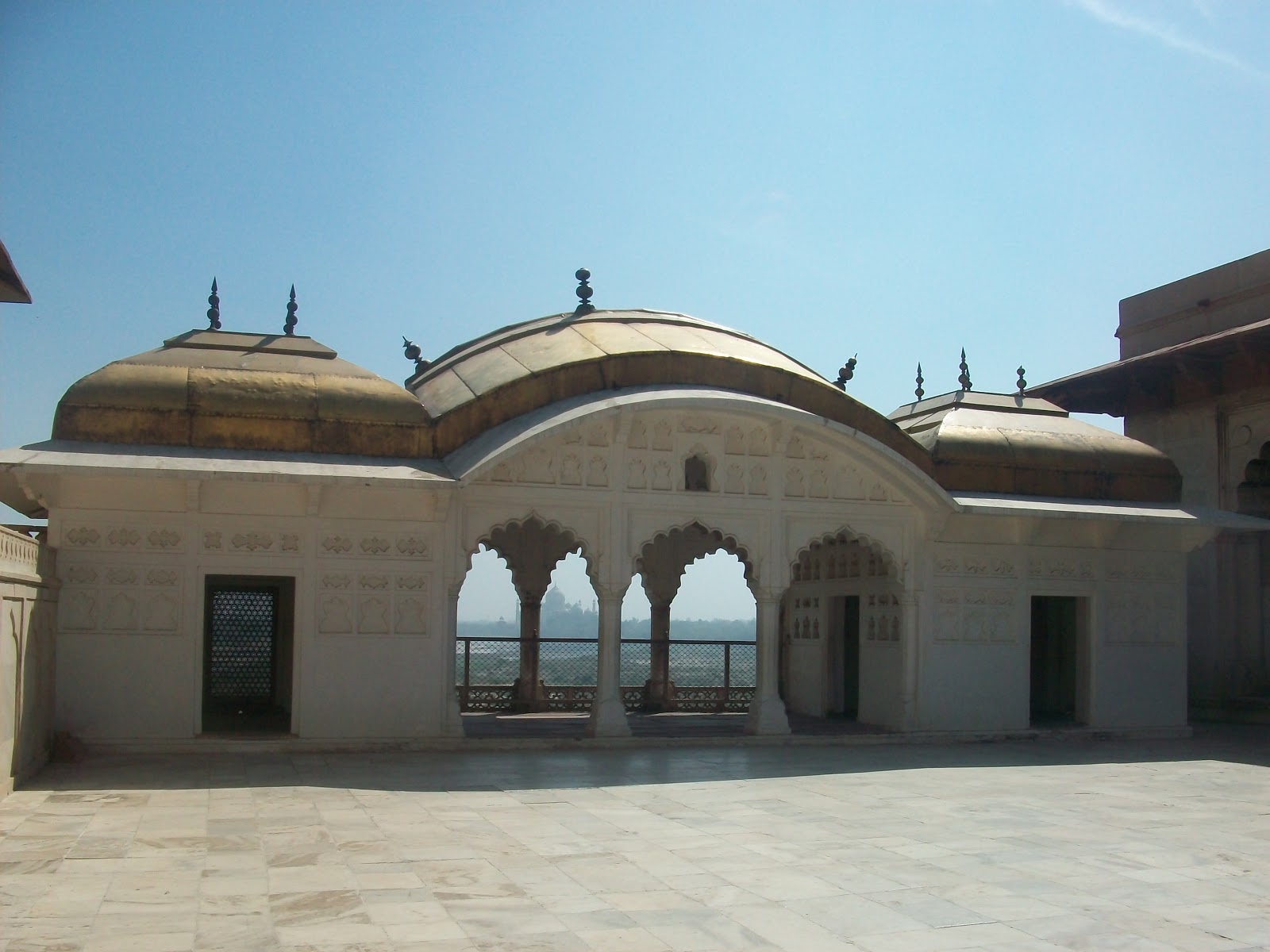
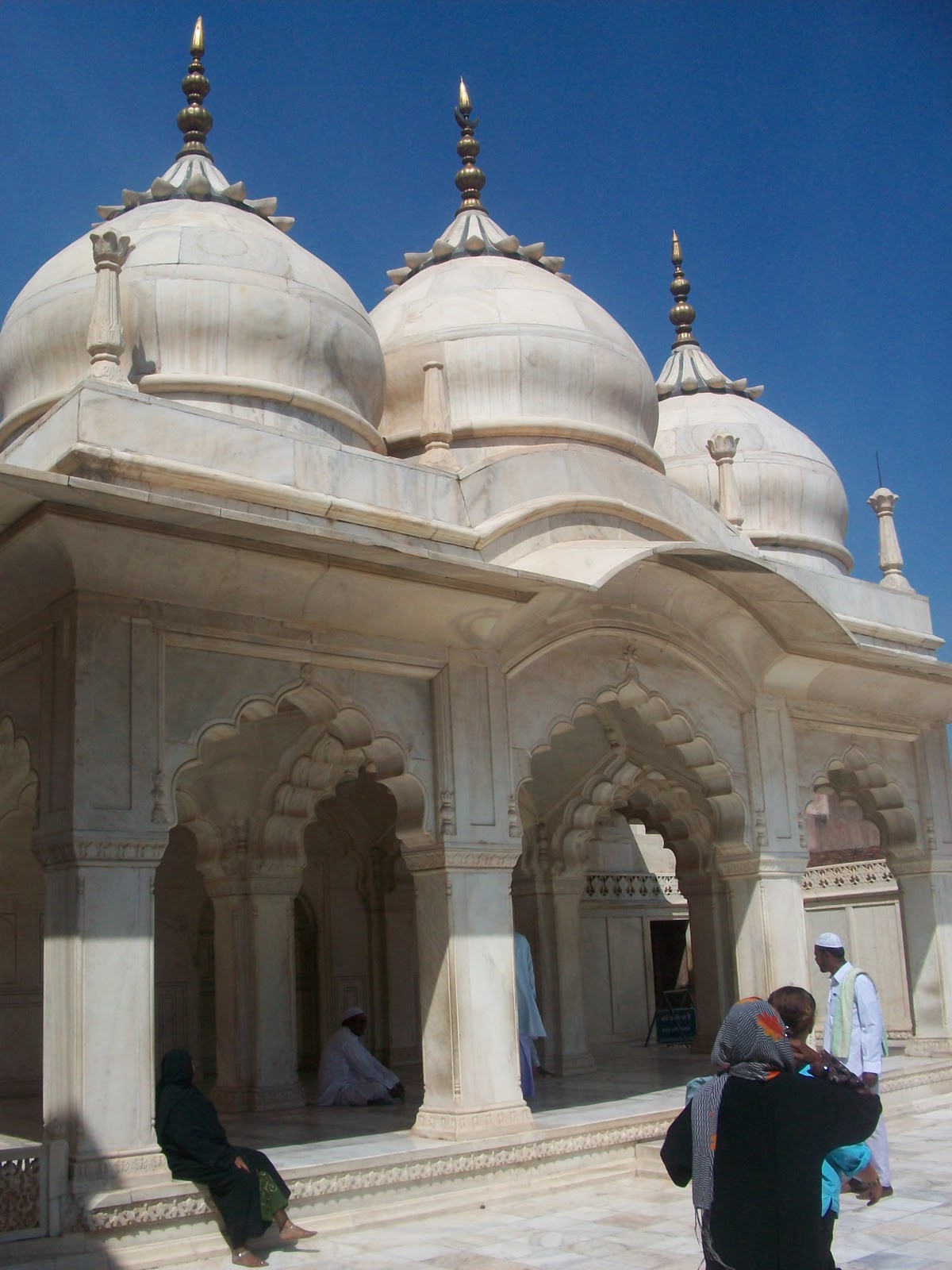
Today we went to an old palace/capital of Akbar the Great’s called "Fatepur Sikhi". 

 The story goes:
Akbar was the 3rd Mughal Emperor with the pressure (as all male rulers of the time) to have a son. Despite the fact that he had 6 wives (concurrently! Not consecutively, as did Henry VIII…) he was unable to produce a LEGITIMATE male heir to carry on the Mughal throne… L (I specify “legit” b.c. in addition to his 6 LEGAL WIVES, he had a buncha concubines… How he found the time for all that AND running a country is beyond me!) So… he was very sad & distraught b.c. he didn’t want the Mughal throne to end with him...

He went to this Guru-priest guy & the guy was like “Don’t worry! You’ll have a son within a year!” Well, what-du-ya-know but his Hindu Rajput princess of a wife bore him one a year later! Naturally he was ECSTATIC! Therefore, in honor of this guru-guy who predicted it, aka made it happen in Akbar’s eyes, Akbar built an entire city and moved his capital to near where the guy was!!

This city took 7 years to build, a buncha money I’m sure, and when it was all said n done- Akbar moved to this city making it his capital for 15 years!

Within this city was a palace, which is where we spent most of our time...
In the palace was first a General Audience hall, or courtyard where the Emperor received the public. This is also where he handed down and performed punishments such as “trampling via elephant”!!! (Imagine being squashed and killed by an elephant! OUCH!)
 
After the courtyard, you entered the private portion of the palace.
The first section was the “Man’s section”.. aka no woman ever went there.
There was the building where Akbar held important meetings with important guys.

To show just how important he was, he stood above them on this central pillar, while all the other guys stood on the floor below looking up at him. Pretty arrogant.

There was a treasury where he kept/”hid” all the money.

There was his bedroom with his “KING” size bed!!

In the center of all the “man buildings” was a place where a magician would perform that was in the center of water. Everyone, including the woman (that were hiding behind windows) would watch him in the evenings.

Akbar even had a water source where the rivers from nearby would be kept in a large storage system to provide water to the palace. Akbar himself, however, was fairly picky and only drank water from the Ganges river itself. That’s why he got his own special water source in the shape of a lotus leaf.

In the woman’s section was a house built just for his mom. What a nice son.

The Hindu Rajput princess who bore him that very important male heir got a palace all to herself!!!! (Poor other wives… L ) In her HUGE palace in the woman’s section- she had a special Winter Palace for the winter months,

Summer Palace for the summer months,

and a Hindu Temple in the middle of the two.

Like all Mughal architecture, it was super focused on symmetry- therefore the four sides surrounding the courtyard were identical. (which makes me think: why do you need an identical palace for summer that you have in winter?! Why not just one for both!? Then again, Akbar was a nice guy- at least to those who were important to him)

There was a section for all his concubines—pretty cramped if you ask me… Of course this was directly linked to his bedroom. (Also, who KNOWS where the other 5 WIVES stayed?!?)

After having lived here for 15 years, invaders from the outside threatened the Mughal reign and Akbar had to shift his capital in order to protect & keep India. After he left, no one came back. L Fatepuh Sikhi was abandoned forever.

As WE abandoned it, on we said goodbye to our awesome guide- Hasnain (Has-Nine) & went to Jaipur- a 5 hour drive! L Upon arrival we checked out our awesome hotel:
 

And went to a FANCY dinner at a 5-star hotel…
 
Which was way better than our "American church" (as one Indian guide referred to it..)
All-in-all: Productive day!

OH! With the exception to: I go to buy some jewelry- not expensive, b.c. you know me (esp if you’re reading my blog..) anyways… my debit card is declined.. I’m like “WTH!! I specifically told my bank that ‘anywhere in ASIA is ok’ " 
After FINALLY getting in touch with them (via Mom, thanks, btw!) she’s informed that:
Basically… 
my American bank is pretty un-intelligent b.c…..
wait for it….
They didn’t realize India was in Asia!!!!!!!!! (OMG!!)
(really makes me wanna keep banking with them… ;) ) 

Monday, March 21, 2011

Day 2-- Agra Fort & Taj Mahal

Today was B-U-S-Y!!! It totally made up for yesterday, that’s fo sho..

First we went to the Agra Fort, which was UH-MAZING!! The fort is actually a palace.. but it’s many palaces inside a fort.. So there were the Mughals (pretty much the most infamous dynasty that ruled India, despite the fact that they were Muslim invaders from the Middle East!!), well the Mughals were rich and brought their awesome architecture to India & were known for combining Hindu & Muslim architecture into one, therefor making it Mughal architecture. Well, the Agra Fort is a key example to what it looks like.
 There were monkeys all around this place too... lol.
 This is just the entrance gate!!!


 So we go into the fort and see Jahangir’s palace first. He was the first one to really live here with his many wives. His dad, Akbar, is the one who really started building the place.. but we just focused our attention on 2 palaces within the walls.. which again, how crazy is it that we only saw 25% of the place and the TWO palaces were HUGE!!!


So. Jahangir—
This building was just his entrance way to his palace!! (These Easterners really like to have HUGE entrance halls…) 

 There was a LARGE bathtub out front that his wife used to frequently bathe in. There were steps so she could get in. pretty big.
 The architecture and art were extremely intricate in every piece of the building-
From the archways
 To the walls:
 To the roof:
 Another quality was the open courtyard to keep the place airy and cool. (This is also very similar to China, Korea, etc…) They all had 4 symmetrical sides surrounding the main attraction, the courtyard. This was supposed to keep things cool throughout the year.


Another thing that was very popular were holes in the ground where they put water to keep it cool. The Mughal royal women were ultra-focused on beauty and would put flowers in the water during the evenings to make things pleasant. 

 In order to keep all kinds of religions/cultures happy, the Mughals incorporated Hindu & Muslim architecture as those 2 were predominant throughout India. Muslims do not believe in capturing any graven image of an individual or any living thing- therefore their art is focused on geometric shapes, symmetry, and detailed shapes. The Hindus, however, believe in art of animals that are important to them—therefore statues and carvings of animals, etc. So this fort shows a mixture of the 2—animals and geometric shapes. (This shows the unity and acceptance of both cultures)

 From the Agra Fort, you can see the Taj Mahal- which was not built during Jahangir’s reign but his son- Shah Jahan. (will get to that later..)
 The fort housed pretty much everybody from royal to court people to military for protection. The fort was surrounded by a 9Meter deep moat with alligators inside. Then the military lived in the barracks surrounding the fort- this was the first line of defense, as in all forts. Finally- the royals obv lived up the highest (75 feet from the ground). So it was REAL hard to get in.
After Jahangir’s palace (mostly in red sandstone, as you see..) was his son’s, Shah Jahan. (This is the guy who built the Taj) Jahan’s palace was mostly in white marble- so you can see a stark difference in the 2 sections of the fort.


Now, Shah Jahan has a very interesting story…
He married 4 women.. His fave wife was Mumtaz (the granddaughter of the Baby Taj guy) who was his 3rd. He loved her SOOOOOOOO much that she was ALWAYS with him… As in most royal marriages and living situations, the husband and wife have their own sleeping quarters- she actually lived with him in the central portion of the palace!! (feel bad for wives 1, 2, & 4 b.c. they slept with the rest of the fam!) Because she was his fave- her children were his fave too.. she had 14 kids BUT only 6 survived- 2 girls and 4 boys. Since the 2 daughters were his fave, b.c. of who their momma was- they each had their own mini-palace on either side of Jahan & Mumtaz’s big central one. 
His youngest daughter's palace:

 His courtyard:
Now, as is Mughal/Indian custom- the oldest son doesn’t just automatically take power when daddy dies- the daddy chooses the best one for the job. Jahan turns 67 and decides his oldest son actually WAS the best for the job- well clearly, sons 2, 3, & 4 didn’t like that. So they decided to go to war against each other- the winner takes the crown! Son # 3- Aurangzeb- wins! (1 is blinded and the other 2 die) Well, Aurangzeb knew his daddy wouldn’t be happy.. so he imprisoned him in his own palace in the Agra Fort for 8 years until his death!! (IMAGINE that?!?! What a son!!) [it’s also rumoured that he imprisoned his dad for bankrupting India due to all the outrageously expensive building projects he started…] 


 The section where he was imprisoned:
 His public audience courtyard, where the market would take place... where he first saw Mumtaz in fell in love with her:
 The Black Onyx throne for the Emperor & Empress:
 He ALSO built her her own Mosque inside their palace inside the fort so she would be welcome and feel at home.

 Now, the fort was still uber-impressive, but more on Shah Jahan..
He loved Mumtaz SOOOOOOOOOOOO much- like more than any man has ever loved a woman- b.c. when she was giving birth to his 14th child, she died. L He was SOOOOOO distraught that he wanted to build her the most amazing mausoleum in the world…. Aka Taj Mahal!! (Uh, I think he succeeded..)


Taj Mahal stands for Crown Palace. Shah Jahan commissioned the work 1 year after she died.. It took 22 years and 20,000 expert workers to build the entire complex!! It stands 75 METERS high… that’s like 200 something feet! It was 40 million Ruppees—which is like, close to 900,000 USD—but remember- this was back in the 1600s!!! so yeah, pretty $$$$$... and all this, for a burial place! (I’m sure EVERY girl would like to find a husband like THAT!!! Yowza!)
Now, usually you just see the white building- well there’s WAY more to the complex..
Due to the focus on symmetry, everything has to be equal. So where there’s one entrance gate there must be 3 more to match it!!
(the entrance gate itself was larger than the entire Tower of London! Ridiculous!)

The “Minarets” or towers were built in order to stabilize the structure in case of earthquakes, etc. Basically, Minarets are only for Mosques- the reason they are with THIS mausoleum is so that in case there was an earthquake, the minarets would go first-falling outward- and therefore, protecting the building itself and Jahan’s precious Mumtaz. 


 As for the architecture itself- it was EXQUISITE!

 Built entirely of white marble, there was the very popular Marble inlay artwork—using gemstones ALL over the place.


As for the Taj, it is also symmetrical where each and every side is IDENTICAL!!! (That makes for some pretty hard work..)

On one side of the Taj, was a Mosque so that Jahan could worship when he was visiting his wife. (b.c. that one was built, one on the other side had to be built as well!)
You can't wear shoes in houses of worship:

 Look in the marble from the archway: You can see Albert Einstein!!! (That's natural!)

I have to say the Taj Mahal was the main reason I came to India- and I have NOT been let down! It’s was uber- impressive and I’ll pretty much never forget it. J